Welcome!
End your joint pain with high performance implant technology from Smith & Nephew.
Enter your ZIP code to get started.
 
Smith & Nephew
PHYSICIAN NAMES *
 
REAL PATIENTS *


BIRMINGHAM HIP Resurfacing System
A high-performance alternative to total hip replacement
Active patients who suffer from hip pain due to arthritis, dysplasia or avascular necrosis may benefit from the bone-conserving approach of the BIRMINGHAM HIP Resurfacing System (BHR Hip), the world’s leading hip resurfacing system.


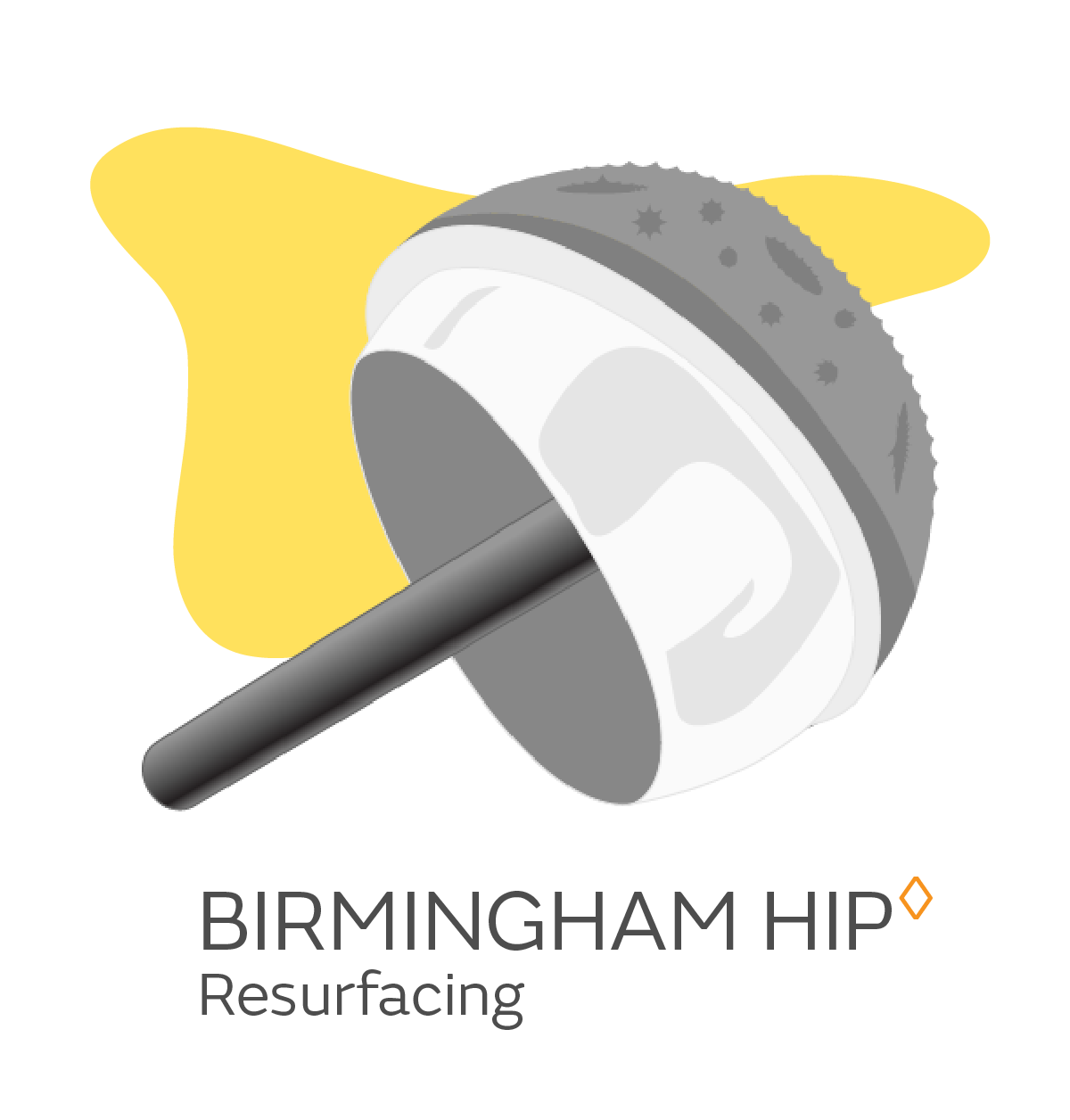
Unlike total hip replacement, the BHR hip resurfaces just a few centimeters of bone, preserving your original joint. The BHR hip is not unlike a cap for a tooth.

Because this technologically advanced surgical procedure resurfaces rather than replaces the end of your femur (thighbone), you may participate in physical activity with an implant that is potentially longer-lasting and more stable than total hip replacements.

In fact, one recent study of nearly 1,000 patients showed the patients who received hip resurfacing experience less thigh pain and function at a higher level of physical activity than patients of a similar age, gender and activity level who received a traditional hip replacement. 1

Candidates for Hip Resurfacing

Hip resurfacing is intended for active patients who are under 60 years of age and in need of a hip replacement. Adults over 60 who are living non-sedentary lifestyles may also be considered for this procedure. However, this can only be further determined by a review of bone quality.

The Implant

The BHR Hip was approved for use in the United States by the Food and Drug Administration in 2006, but has been implanted around the world more than 125,000 times since 1997. Surgeons who offer this implant to patients have undergone specialized training.

Find a surgeon in your area that has been trained to use the BHR Hip.  
zip


The benefits to patients of the BHR Hip technique and implant are significant. The implant’s head size, its bearing surfaces and its bone-sparing technique make it a preferred choice for active patients.

While the implant’s rate of survivorship is comparable to standard total hip replacements after five years, these three key advantages set the resurfacing technique and implant apart from its total hip replacement counterparts.

Head Size

While the implant closely matches the size of your natural femoral head, it is substantially larger than the femoral head of most total hip replacements. This increased size translates to greater stability in your new joint, and it decreases the chance of dislocation of your implant after surgery.

The Bearing Surface

The BHR Hip takes advantage of one of the orthopaedic medical industry’s most technologically advanced bearing surfaces. The surfaces of the ball and the socket are made from materials that dramatically reduce joint wear when compared to traditional hip implant materials (cobalt chrome metal and polyethylene).

The Bone Conservation

The BHR Hip implant conserves substantially more bone than a total hip replacement. Since it preserves your natural femoral neck and most of your femoral head, concerns about leg length discrepancy are virtually non-existent. Also, should you need the implant replaced at some point in the future, you are a candidate for regular total hip replacement surgery as opposed to needing a more traumatic and complex revision surgery as is often the case when a traditional hip replacement needs to be replaced.

The Procedure

Total hip replacement requires the removal of the femoral head and the insertion of a hip stem down the shaft of the femur. Hip resurfacing preserves the femoral head and the femoral neck. During the procedure, your surgeon will only remove a few centimeters of bone around the femoral head, shaping it to fit tightly inside the BHR Hip implant.

Your surgeon will also prepare the acetabulum for the metal cup that will form the socket portion of the ball-and-socket joint. While the resurfacing component slides over the top of the femoral head like a tooth cap, the acetabular component is pressed into place much like a total hip replacement component would be.

Why BIRMINGHAM HIP Resurfacing?

Long-term successful outcomes around the globe.

  • 2009 Australian Registry’s results showed BHR Hip’s survivorship at 8 years (95%) is better than all other resurfacing implants’ survivorship after just their 5th year. 2
  • 2008 Australian Registry’s study found that resurfacing devices outperformed total hip replacement for men under age 55, as well as ages 55-64. 3
  • Great Britain’s Owestry Outcomes Centre’s patient registry revealed BHR Hip’s 10-year survivorship of 95.4%, with 98.6% of patients rating their opinion of the experience as “pleased” or “extremely pleased.” 4
  • A study presented at the American Academy of Orthopaedic Surgeons 2010 Annual Meeting discussed importance of several factors in successful outcomes of resurfacing hip replacements. One factor was prosthesis selection, and it showed that BHR Hip had a significantly lower risk of revision than other hip resurfacing options. 5
Click HERE to read more clinical results for the BHR Hip 
Click HERE to read the BHR Hip's indications for use

References

  1. Barrack R,. The Case for Hip Resurfacing: A Bigger Picture. Current Concepts in Joint Replacement Meeting. December 2010.
  2. Australian Orthopaedic Association National Joint Replacement Registry Annual Report. Adelaide: AOA; 2009.
  3. Australian Orthopaedic Association National Joint Replacement Registry Annual Report. Adelaide: AOA; 2008.
  4. Robinson E, Richardson JB, Khan M. MINIMUM 10 YEAR OUTCOME OF BIRMINGHAM HIP RESURFACING (BHR), A REVIEW OF 518 CASES FROM AN INTERNATIONAL REGISTER. Oswestry outcome centre, Oswestry, UK.
  5. Graves S, De Steiger R, Davidson D, Ryan P, Miller L, Stanford T, Tomkins A. Resurfacing Hip Replacement: Outcomes at 8 years - An analysis of 12,093 primary procedures. Podium presentation # 669. Proceedings of the American Academy of Orthopaedic Surgeons Annual Meeting, New Orleans LA. 2010

There are potential risks with hip resurfacing surgery such as fracture, infection, loosening, dislocation and wear that may result in the need for additional surgery. The results and physical activities of this patient may not be representative of the results and physical activities that you may experience following surgery. Females of child-bearing age should not have the BHR™ device. It is unknown whether metal ions released by the device could harm an unborn child. Do not performhigh impact activities such as running and jumping during the first post operative year while the bone is healing. Early device failure (breakage or loosening may occur if you do not follow your surgeon’s limitations on activity level. Early failure can happen if you do not guard your hip joint from overloading due to activity level, failure to control body weight, or accidents such as falls. Hip resurfacing surgery is intended to relieve hip pain and improve hip function. Talk to your doctor to determine what treatment may be best for you. Additional BIRMINGHAM HIP™ replacement patient information is provided at www.bhrhip.com.

Find a Physician
Not every orthopedic surgeon is trained to use the BHR Hip.
 
Find the surgeons in your area who use the BHR Hip by entering your ZIP code or city and state below.
zip city state
 
  © 2013 Smith & Nephew ◊ Trademark of Smith & Nephew